The Stories the Diaspora Never Stopped Telling
The Greeks survived 400 years of occupation by keeping the story alive. We're not done keeping it — heroes, heroines, and forgotten history, every claim traced to a source.
Heroes. Heroines. The customs performed without anyone remembering why. The music the state tried to ban. The families who carried it all to new countries. For Greeks in America, Australia, the UK, Canada, Germany — everywhere the family landed — this channel exists to keep it that way.
— Stavros, Krios
Watch the Episodes ↗Every episode is built on a concrete human anchor, not an abstract concept. Four pillars hold the whole channel up.
Season 1 built the foundation. Season 2 is where the real mission lives — heroes, heroines, and forgotten history for the diaspora. Primary sources only. Oldest cited, not most famous.
01
War & Strategy
Homer opens the Iliad with menis — not ordinary anger. Achilles didn't sulk. He was orchestrating a precise, calculated revenge.
Watch episode ↗
02
Heroes & Tragedy
Books 9–12 are narrated by Odysseus himself, at a dinner party, to an audience whose ships he needs. Every character calls him a liar.
Watch episode ↗
03
War & Strategy
There were 7,000 men at Thermopylae, not 300. The 700 Thespians fought to the last — nobody makes films about them.
Watch episode ↗
04
Heroes & Tragedy
Before the twelve labours, Hera drove Heracles temporarily insane and he murdered his own family. The labours were penance.
Watch episode ↗
05
Heroes & Tragedy
Medusa was a priestess of Athena. Poseidon assaulted her in Athena's own temple. Athena punished Medusa — not Poseidon.
Watch episode ↗
06
Place & History
There are nine cities buried at Hisarlik. Schliemann dug straight through the one that matched Homer's timeline.
Watch episode ↗
07
Place & History
The palace at Knossos had hundreds of rooms and no straight corridors. Theseus was a political myth built on an archaeological reality.
Watch episode ↗
08
Place & History
Before Delos became Apollo's sacred island, it was the centre of the Cycladic civilisation. The marble idols were originally painted.
Coming soon
09
Place & History
The Parian Chronicle — a marble stele found on Paros — is one of the only surviving Greek chronologies. It dates the Trojan War.
Coming soon
10
Place & History
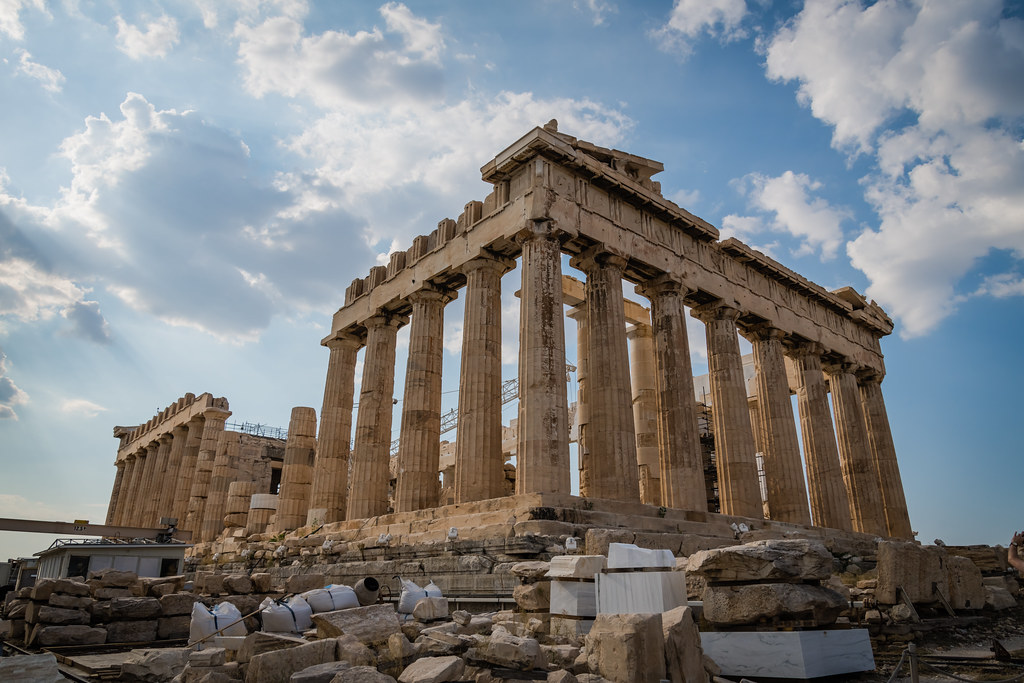
The Acropolis was a Mycenaean palace before it was a temple. Its marble came from the same Cycladic quarries as the Parian Chronicle.
Coming soonA Greek soldier refused to surrender to the Ottomans at the bridge of Alamana in 1821. He was 24. What he said before they killed him changed the revolution. Primary sources only.
Watch Episode ↗Entire villages in the Aegean maintained Orthodox Christian identity for 200+ years under Ottoman rule. In Japan, the Kakure Kirishitan faced the same impossible choice: perform conformity or die.
Watch Episode ↗Laskarina Bouboulina outfitted three warships at her own expense, led fleets into battle, and became the first woman ever named Admiral of the Russian Navy.
Watch Episode ↗Born in refugee slums after the 1923 population exchange, rebetiko carried the sound of loss and displacement into every Greek community it touched.
Watch Episode ↗Manto Mavrogenous funded ships, soldiers, and relief for the Greek Revolution with her own fortune — and was never repaid a single drachma.
Watch Episode ↗The Great Famine of 1941–1942 killed an estimated 300,000 Greek civilians under Axis occupation and blockade — and the one neutral ship that finally broke through.
Watch Episode ↗A ritual older than Greece as we'd recognize it, still served to every guest who walks through a Greek door — including the ones asking for your daughter's hand.
Watch Episode ↗
The Greeks survived 400 years of occupation by keeping the story alive. We're not done keeping it.
Primary sources. Cross-cultural evidence. Five exhibits. One verdict. No login required. The companion case to EP006 — Troy.
Homer's Iliad — written 400 years after the events it describes.
Hittite Tablets — Wilusa Treaty (Alaksandu), c. 1280 BCE.
Schliemann's excavation notes, 1871-1873. He dug the wrong layer.
Linear B tablets from Mycenae — bronze weapons inventory.
Korfmann excavations 1988-2005 — Troy VIIa matches Homer.
No secondary sources used without a primary source to back them. Oldest source cited, not most famous. If we cannot trace a claim to a primary source, we do not make the claim.
Paros Island — home of the Parian Chronicle, 264 BCE
What the primary sources actually say — sent after every episode. Direct quotes, contradictions between sources, the detail that didn't make the cut.
One email per episode. No schedule. No other content. Unsubscribe instantly.
The word behind
the story. And why it matters.
Every episode has a Greek word at its centre — ancient or modern. Not the translation — the original. Because the translation is always a decision someone else made for you.
Primary sources only. Oldest source cited, not most famous. If we cannot trace a claim to a primary source, we do not make the claim. That is the Stavros Commentary rule — applied to every episode, every claim.
Respect — the kind owed, not the kind requested. The word this channel closes on whenever the debt a story is telling was never actually repaid.
Not ordinary anger. Divinely-sanctioned, cosmically consequential wrath. No other mortal in Homer gets menis — only gods and Achilles alone. That tells you everything about what Homer thought of him.
Cunning intelligence. Practical wisdom. The Odyssey is not a story about a man trying to get home — it is a story about the most dangerous kind of intelligence.